Xi'an西安
An ancient capital that still stages the idea of Chang’an.
Xi’an is most compelling when the Terracotta Army, Buddhist translation, city walls and modern Tang-themed nightlife are treated as different layers—not blended into one vague “ancient China.” The city was Chang’an, eastern starting point of Silk Road exchange and capital of several dynasties.
An ancient capital that still stages the idea of Chang’an.
Qin power appears outside today’s city at the mausoleum of the First Emperor, where thousands of individualized clay soldiers served an imperial afterlife. Tang Chang’an tells a different story: a cosmopolitan capital connected to Central Asia, Buddhism, trade and scholarship.
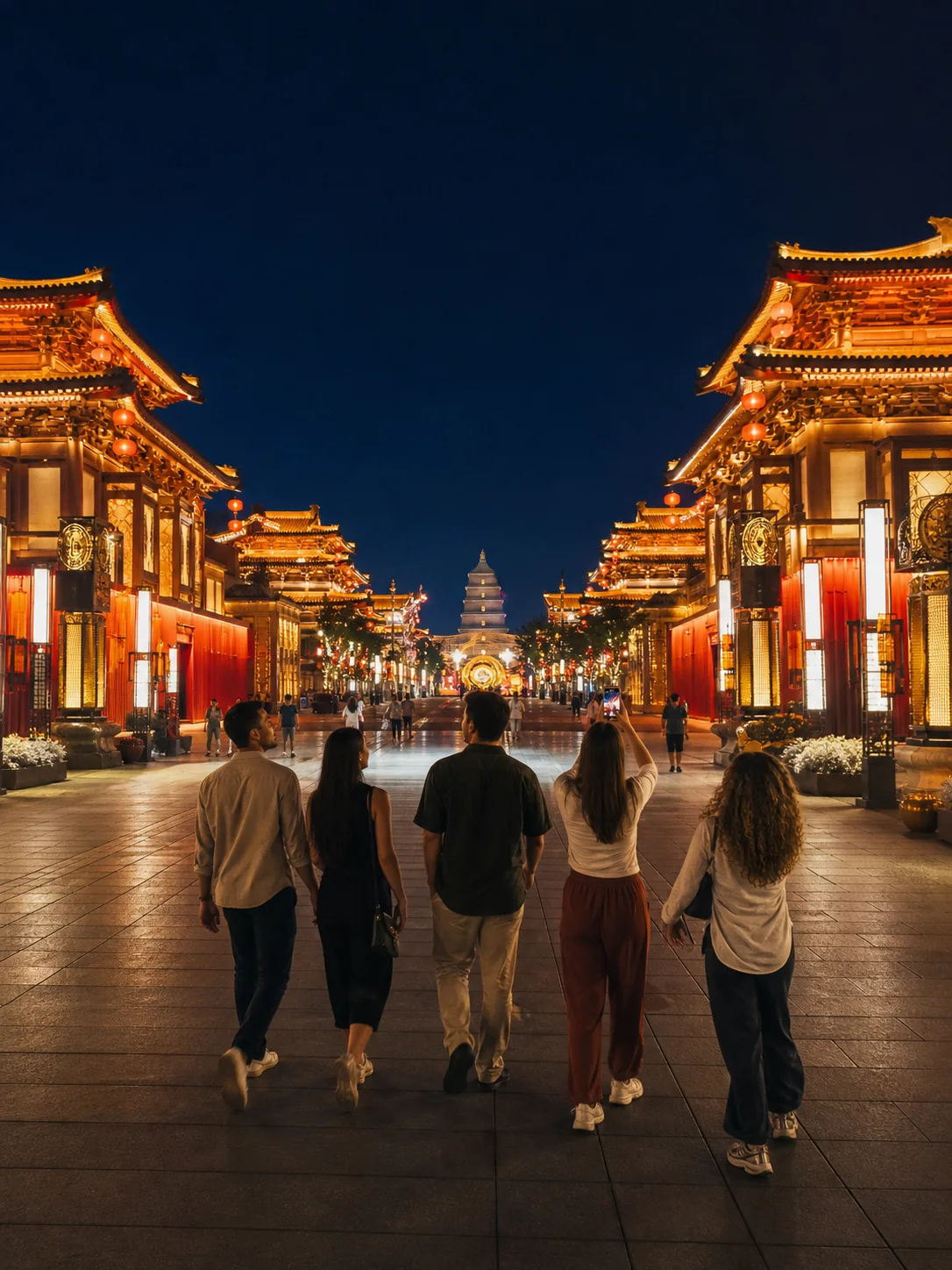
Grand Tang Mall—also called Datang Everbright City—is a modern cultural pedestrian district, not a preserved Tang street. Its value lies in how contemporary Xi’an performs and reimagines Tang confidence through light, costume, music and crowds.
A short timeline before the long walk
Qin Shi Huang unifies rival states and becomes the First Emperor.
Han Chang’an grows as an imperial capital and Silk Road node.
Tang Chang’an becomes one of the world’s largest and most cosmopolitan cities.
Xuanzang oversees construction of the Giant Wild Goose Pagoda for Buddhist texts and images.
Meet the names behind the monuments
Qin Shi Huang
The First Emperor unified China; his vast mausoleum complex produced the Terracotta Army.
Xuanzang
Monk and translator whose journey to India and work in Chang’an shaped East Asian Buddhism.
Emperor Gaozong and Empress Wu
Their era connects court power, Buddhism and the Giant Wild Goose Pagoda’s early history.
8 places worth understanding—not just photographing
Every place below has its own complete story page with history, named people, what to notice, route options, public transport, the exact Chinese taxi pin, nearby stay areas and food planning.
Emperor Qinshihuang’s Mausoleum Site Museum
秦始皇帝陵博物院The figures are not merely an army of identical statues. Faces, ranks, hairstyles, armour and formation create an administrative vision of empire. The unexcavated burial mound also reminds visitors that archaeology is an ongoing ethical and technical decision.
Terracotta warriors, imperial unification and archaeologyOPEN COMPLETE GUIDE →02 · Visit the pagoda area in late afternoon, eat nearby, then walk the lit district after darkGiant Wild Goose Pagoda & Grand Tang Mall
大雁塔 · 大唐不夜城The pagoda is tied to Xuanzang’s translation project and the movement of Buddhist knowledge. The illuminated pedestrian district south of it is a modern interpretation of Tang culture. Seeing both prevents spectacle from replacing history.
Buddhist translation by day, Tang-inspired performance by nightOPEN COMPLETE GUIDE →03 · Allow 2–3 hours for one section or more for a full circuitXi'an City Wall
西安城墙The surviving Ming wall follows a long tradition of capital enclosure. Gates controlled movement and defence; today the broad top makes the city’s rectangular logic unusually easy to grasp.
Ming fortification and a readable old-city planOPEN COMPLETE GUIDE →04 · 3–5 hoursBell Tower, Drum Tower & Muslim Quarter
钟楼 · 鼓楼 · 回民街Move from official timekeeping into a living Hui Muslim neighbourhood.
MING LANDMARKS · HUI NEIGHBOURHOODOPEN COMPLETE GUIDE →05 · 3–5 hoursShaanxi History Museum
陕西历史博物馆The museum explains why Xi’an was more than one dynasty and one army.
ARCHAEOLOGY MUSEUMOPEN COMPLETE GUIDE →06 · 3–5 hoursHuaqing Palace & Lishan
华清宫 · 骊山One hot-spring landscape holds both Tang romance and a twentieth-century political crisis.
ROYAL SPRINGS · MODERN HISTORYOPEN COMPLETE GUIDE →07 · 2–4 hoursDaming Palace National Heritage Park
大明宫国家遗址公园The empty foundations are the story: scale survives even when palaces do not.
TANG PALACE ARCHAEOLOGYOPEN COMPLETE GUIDE →08 · 2–3 hoursSmall Wild Goose Pagoda & Xi'an Museum
小雁塔 · 西安博物院A quieter pagoda shows how Buddhism, earthquakes and urban memory endure together.
TANG BUDDHISM · CITY MUSEUMOPEN COMPLETE GUIDE →Start with these anchors—then use the complete directory above
Emperor Qinshihuang’s Mausoleum Site Museum
秦始皇帝陵博物院The figures are not merely an army of identical statues. Faces, ranks, hairstyles, armour and formation create an administrative vision of empire. The unexcavated burial mound also reminds visitors that archaeology is an ongoing ethical and technical decision.
Terracotta warriors, imperial unification and archaeologyOpen the complete Terracotta Army story: pits, people and archaeology →Protect at least half a day; reserve through the current official route and carry the original passport.
Most first-time visitors stay inside/near Xi’an’s city wall. Lintong works only if hot springs and the museum justify an overnight.
A common independent route uses Line 9 toward Huaqingchi and an onward official bus/taxi; verify the current museum connection before departure.
Pin the official museum visitor entrance in Lintong, not simply “Terracotta Army”; agree whether a car waits or ends the trip.
Return to Xi’an for broader choice, or confirm prices at Lintong restaurants before ordering.
Giant Wild Goose Pagoda & Grand Tang Mall
大雁塔 · 大唐不夜城The pagoda is tied to Xuanzang’s translation project and the movement of Buddhist knowledge. The illuminated pedestrian district south of it is a modern interpretation of Tang culture. Seeing both prevents spectacle from replacing history.
Buddhist translation by day, Tang-inspired performance by nightOpen the complete Grand Tang Mall night story and route →Visit the pagoda area in late afternoon, eat nearby, then walk the lit district after dark; check current performance notices.
Qujiang and Dayanta are the closest stay zones; the Bell Tower gives stronger old-city access but requires a late return.
Dayanta station is the core anchor. Crowds after performances can make the nearest exit and return route important.
Pin a precise north/south meeting point or mall entrance. Road closures may push pickup away from the pedestrian street.
Look for biangbiang noodles, roujiamo and paomo; Muslim Quarter food is a separate cultural experience, not simply the closest meal.
Xi'an City Wall
西安城墙The surviving Ming wall follows a long tradition of capital enclosure. Gates controlled movement and defence; today the broad top makes the city’s rectangular logic unusually easy to grasp.
Ming fortification and a readable old-city planOpen the complete Xi’an City Wall story: gates, defence and cycling →Allow 2–3 hours for one section or more for a full circuit; heat, wind and bicycle availability change the experience.
South Gate/Yongningmen for nightlife and wall access; Bell Tower for central convenience; quieter eastern areas for less noise.
Yongningmen is the common south-gate anchor. Confirm which gate sells/accepts the current ticket and its closing time.
Use the exact gate name in Chinese. Different gates are kilometres apart by road.
Walk toward the Muslim Quarter for halal Shaanxi traditions, or south for modern dining and cafés.
Hotel and transport freshness: the stay guidance recommends areas rather than promising a particular property’s live inventory. Before paying, verify the exact hotel, foreign-passport guest name, cancellation terms, metro exit and vehicle pickup point in the current provider or map.
Eat the city, not a generic checklist
Biangbiang noodles
Wide hand-pulled noodles dressed with chilli, vinegar and aromatics; texture is central to the dish.
Roujiamo
Chopped braised meat in a crisp wheat bun, often described too simply as a “Chinese burger.”
Yangrou paomo
Lamb broth with bread broken into small pieces by the diner; the preparation is part of the experience.
The one transport rule to remember
Xi’an’s historic core is compact, but the Terracotta Army is outside the city and airport/railway stations sit on different corridors. Keep Chinese names for Xi’an North railway station, your city-wall gate and the exact Lintong museum.
Sources used for this city story
Reviewed 23 August 2026. Historical interpretation is based on the sources below; ticketing, opening, transport, hotel and restaurant conditions can change and must be checked again before payment or travel.