Shanghai上海
A port city where every river view contains two centuries.
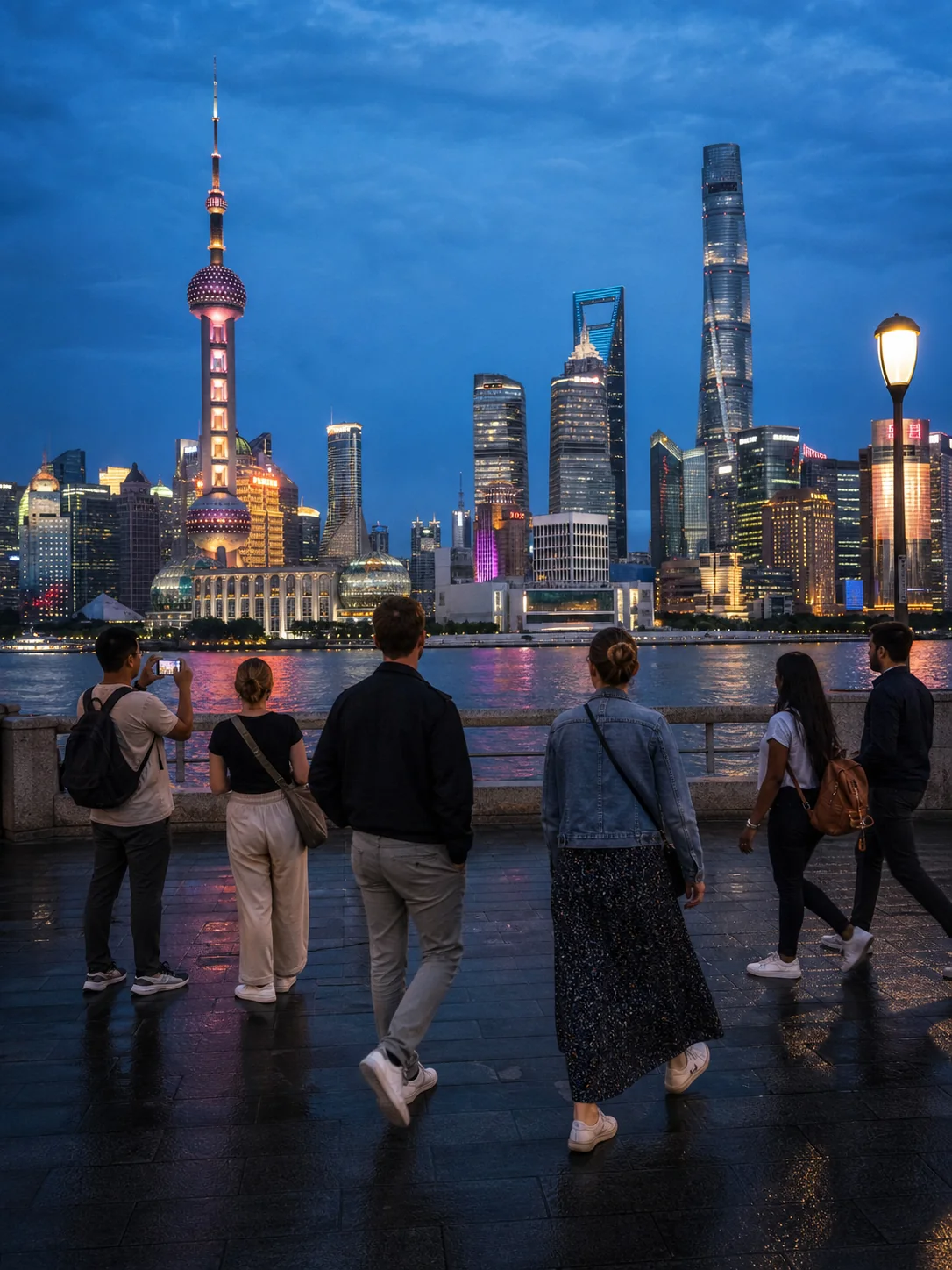
Shanghai’s most powerful story is visible across the Huangpu: the stone-faced commercial waterfront of the Bund faces the vertical skyline of Pudong. One view compresses treaty-port history, industrial ambition, finance and the speed of post-1990 urban change.
A port city where every river view contains two centuries.
The Bund’s buildings are often described as European styles, but the deeper story is commercial power: banks, trading houses and maritime networks turned this curve of river into a global business address. Read the façades as institutions, not decoration.
Move inland and the story becomes domestic and intimate. Lane houses, plane trees and former concession streets reveal how global influence was absorbed into neighbourhood life. Cross to Pudong and the scale changes again: an area of docks and fields becomes a symbol of national modernity.
A short timeline before the long walk
Shanghai opens as a treaty port, accelerating foreign trade and settlement.
The Bund and international concessions reach their commercial and cultural peak.
The city’s economic role changes under the People’s Republic.
Pudong’s development creates the skyline now facing the historic Bund.
Meet the names behind the monuments
Sir Victor Sassoon
A prominent businessman whose hotels and buildings embody the city’s cosmopolitan commercial age.
Soong Ching-ling
Her former residence connects elite Shanghai life with the political history of modern China.
I. M. Pei
Shanghai-born architect whose global career helps frame the city’s long exchange between Chinese and international modernism.
8 places worth understanding—not just photographing
Every place below has its own complete story page with history, named people, what to notice, route options, public transport, the exact Chinese taxi pin, nearby stay areas and food planning.
The Bund
外滩Walk slowly enough to identify banks, customs buildings and clubs. The Customs House clock and the former Hongkong and Shanghai Bank building make the waterfront’s institutional purpose clear; Pudong across the river supplies the modern counter-image.
Historic commercial architecture facing the Pudong skylineOPEN COMPLETE GUIDE →02 · Choose a 2–4 km route rather than wandering without an endpointFormer French Concession walks
衡复历史文化风貌区The value is not a single “French” landmark. Villas, lilong lanes, schools, residences and shops show how imported planning and local urban life mixed over time. Read it as a lived district, not a themed attraction.
Tree-lined streets, lane-house urbanism and modern Chinese livesOPEN COMPLETE GUIDE →03 · Allow 2–4 hoursLujiazui
陆家嘴Pudong’s skyline is a planned statement about finance and reform-era development. At ground level, elevated walkways and supertall towers reveal a city designed at a different scale from the Bund.
Reform-era skyline and views back toward historic ShanghaiOPEN COMPLETE GUIDE →04 · 3–4 hoursYu Garden & Old City
豫园 · 上海老城厢Pass through the crowded market to find a private garden built as a world in miniature.
MING GARDEN · OLD CITYOPEN COMPLETE GUIDE →05 · 3–5 hoursShanghai Museum
上海博物馆Use objects—not dynastic slogans—to build a visual history of China.
CHINESE ART MUSEUMOPEN COMPLETE GUIDE →06 · Half or full dayZhujiajiao Water Town
朱家角古镇The bridges matter because water once organised work, trade and home.
JIANGNAN WATER TOWNOPEN COMPLETE GUIDE →07 · 1–2 hoursJade Buddha Temple
玉佛禅寺A living monastery shaped by migration, modern Shanghai and two Burmese jade images.
CHAN BUDDHIST TEMPLEOPEN COMPLETE GUIDE →08 · 1.5–2.5 hoursLonghua Temple & Pagoda
龙华寺 · 龙华塔Shanghai’s modern skyline has an older sacred counterpoint.
BUDDHIST TEMPLEOPEN COMPLETE GUIDE →Start with these anchors—then use the complete directory above
The Bund
外滩Walk slowly enough to identify banks, customs buildings and clubs. The Customs House clock and the former Hongkong and Shanghai Bank building make the waterfront’s institutional purpose clear; Pudong across the river supplies the modern counter-image.
Historic commercial architecture facing the Pudong skylineOpen the complete Bund story: institutions, buildings and two-bank route →Allow 1.5–3 hours; early morning is calmer, while blue hour gives the strongest skyline transition.
The Bund for landmark hotels; East Nanjing Road for transport and shopping; People’s Square for wider city access.
East Nanjing Road is the normal metro anchor, followed by a walk east. Check the exact river section and building you want.
Pin a specific Bund building or intersection; weekend road controls and crowds can move pickup points.
Walk inland for xiaolongbao, shengjian mantou and scallion-oil noodles rather than choosing only river-view restaurants.
Former French Concession walks
衡复历史文化风貌区The value is not a single “French” landmark. Villas, lilong lanes, schools, residences and shops show how imported planning and local urban life mixed over time. Read it as a lived district, not a themed attraction.
Tree-lined streets, lane-house urbanism and modern Chinese livesOpen the complete district story and respectful walking route →Choose a 2–4 km route rather than wandering without an endpoint; respect residential privacy.
Stay around Hengshan Road, Huaihai Road or Jing’an depending on nightlife, metro and hotel preference.
South Shaanxi Road, Hengshan Road and Shanghai Library can anchor different walks; match the station to the exact route.
Use the Chinese name of a museum, former residence or intersection. “French Concession” is too broad for a driver pin.
Pair the walk with local noodles, pork chop rice cakes, pastries or a contemporary Shanghai café.
Lujiazui
陆家嘴Pudong’s skyline is a planned statement about finance and reform-era development. At ground level, elevated walkways and supertall towers reveal a city designed at a different scale from the Bund.
Reform-era skyline and views back toward historic ShanghaiOpen the complete Lujiazui development story and skyline route →Allow 2–4 hours; choose one observation deck rather than buying several similar views.
Lujiazui for river and business hotels; Century Avenue for transport; the Bund if the west-bank evening experience matters more.
Lujiazui station is the central anchor. Underground passages and elevated walkways mean the nearest exit matters.
Pin the exact tower or mall entrance and confirm the pickup level; large complexes can have several vehicle zones.
Use a mall for easy multilingual choice, or return west for more characterful Shanghainese neighbourhood dining.
Hotel and transport freshness: the stay guidance recommends areas rather than promising a particular property’s live inventory. Before paying, verify the exact hotel, foreign-passport guest name, cancellation terms, metro exit and vehicle pickup point in the current provider or map.
Eat the city, not a generic checklist
Xiaolongbao
Thin-skinned soup dumplings; lift carefully and allow steam to escape before eating.
Shengjian mantou
Pan-fried buns with a crisp base and hot filling, strongly associated with everyday Shanghai.
Scallion-oil noodles
A simple bowl whose fragrance and texture show the city’s preference for precise, restrained flavours.
The one transport rule to remember
Two airports, multiple railway stations and opposite riverbanks make exact names essential. Build days west or east of the Huangpu, and do not assume a river crossing is a short walk just because the skylines appear close.
Sources used for this city story
Reviewed 23 August 2026. Historical interpretation is based on the sources below; ticketing, opening, transport, hotel and restaurant conditions can change and must be checked again before payment or travel.