Chengdu成都
A fertile basin capital where leisure is a serious urban art.
Chengdu is often reduced to pandas and spicy food. Its deeper identity joins an ancient irrigated plain, Shu history, tea-house sociability, Sichuan opera and one of China’s most influential culinary traditions.
A fertile basin capital where leisure is a serious urban art.
The Chengdu Plain’s long prosperity is inseparable from water management, especially Dujiangyan outside the city. Within Chengdu, the Wuhou Shrine turns the Three Kingdoms into a landscape of memory, loyalty and popular storytelling.
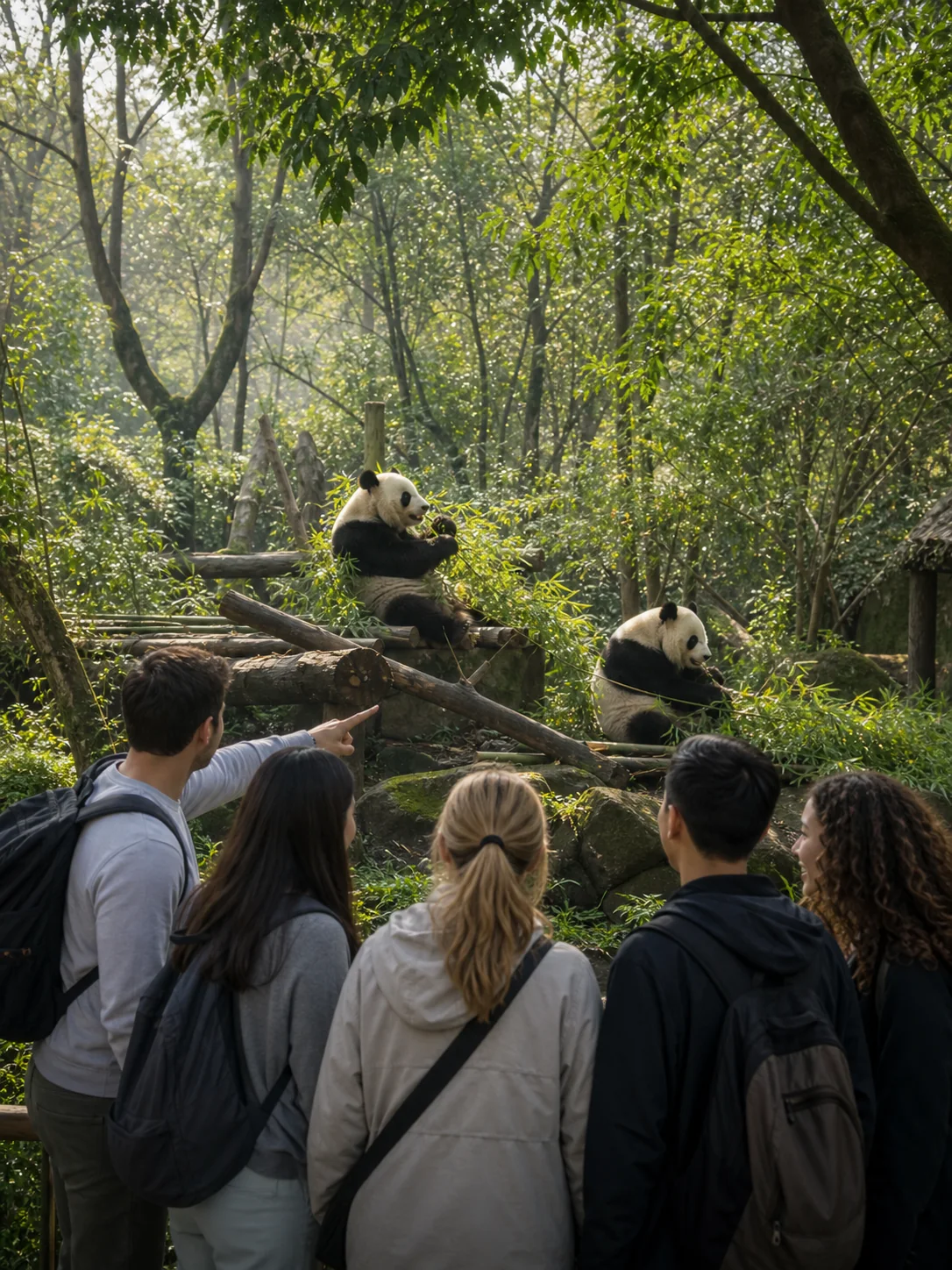
The panda base represents a modern conservation mission rather than a petting attraction. Visit early, read the research context and allow the animals’ own rhythms—not a guaranteed performance—to control the morning.
A short timeline before the long walk
The ancient Shu capital develops in the Chengdu Plain.
Li Bing’s Dujiangyan irrigation system reshapes agriculture and flood control.
Chengdu serves as capital of Shu Han during the Three Kingdoms period.
UNESCO names Chengdu a Creative City of Gastronomy.
Meet the names behind the monuments
Li Bing
Engineer associated with Dujiangyan, showing how water management underpinned the region’s prosperity.
Zhuge Liang
Shu Han strategist commemorated at Wuhou Shrine and transformed into a symbol of intelligence and loyalty.
Du Fu
Poet whose Chengdu thatched cottage links national upheaval with intimate observations of ordinary life.
8 places worth understanding—not just photographing
Every place below has its own complete story page with history, named people, what to notice, route options, public transport, the exact Chinese taxi pin, nearby stay areas and food planning.
Chengdu Research Base of Giant Panda Breeding
成都大熊猫繁育研究基地The base combines breeding, research, conservation education and public display. Giant pandas are most active in cooler hours; the experience should be about observing behaviour and habitat, not forcing a close encounter.
Modern conservation and Sichuan’s global animal iconOPEN COMPLETE GUIDE →02 · Allow 2–3 hoursWuhou Shrine & Jinli
武侯祠 · 锦里The shrine commemorates Liu Bei and Zhuge Liang, binding history to the later cultural memory of the Romance of the Three Kingdoms. Neighbouring Jinli is a commercial heritage-style street; separate the memorial’s history from the street’s performance.
Three Kingdoms memory and popular storytellingOPEN COMPLETE GUIDE →03 · Allow 1.5–3 hoursPeople’s Park & tea-house life
人民公园The park makes Chengdu’s public sociability visible: tea, conversation, music, matchmaking notices and slow time. It is not “doing nothing”; it is a way the city occupies shared space.
Tea-house rhythm and everyday ChengduOPEN COMPLETE GUIDE →04 · Allow most of a day from Chengdu, or stay overnight when pairing it with Mount Qingcheng.Dujiangyan Irrigation System
都江堰水利工程Li Bing’s third-century-BCE system controls flood, sediment and irrigation without a main blocking dam. Yuzui, Feishayan and Baopingkou must be read together; later maintenance is part of its authenticity as living infrastructure.
Ancient hydraulic engineering still serving the Chengdu PlainOPEN COMPLETE GUIDE →05 · Full dayMount Qingcheng
青城山A forested mountain became one of Daoism’s foundational landscapes.
TAOIST SACRED MOUNTAINOPEN COMPLETE GUIDE →06 · 2.5–4 hoursJinsha Site Museum
金沙遗址博物馆Long before pandas and teahouses, Chengdu held an extraordinary bronze-age ritual centre.
ANCIENT SHU ARCHAEOLOGYOPEN COMPLETE GUIDE →07 · 2–3 hoursDu Fu Thatched Cottage
杜甫草堂The house is reconstructed; the exile, poems and Chengdu landscape are real.
POETRY · MEMORIAL LANDSCAPEOPEN COMPLETE GUIDE →08 · Full daySanxingdui Museum
三星堆博物馆The bronze faces are startling because they belong to a sophisticated world outside the old textbook centre.
ANCIENT SHU CIVILISATIONOPEN COMPLETE GUIDE →Start with these anchors—then use the complete directory above
Chengdu Research Base of Giant Panda Breeding
成都大熊猫繁育研究基地The base combines breeding, research, conservation education and public display. Giant pandas are most active in cooler hours; the experience should be about observing behaviour and habitat, not forcing a close encounter.
Modern conservation and Sichuan’s global animal iconOpen the complete panda conservation story and early-visit plan →Book through the current official route and enter early; confirm which base/zone the ticket covers.
Central Chunxi Road/Tianfu Square keeps evenings flexible. Stay near the base only if an early visit outweighs city access.
Panda Avenue is a common transfer anchor, with an onward shuttle/bus/taxi. Check the current official arrival instructions.
Pin the exact base and gate in Chinese; the wider site has multiple zones and crowd controls.
Eat after the early visit in central Chengdu; morning vendors near transport hubs are best treated as convenience, not the culinary highlight.
Wuhou Shrine & Jinli
武侯祠 · 锦里The shrine commemorates Liu Bei and Zhuge Liang, binding history to the later cultural memory of the Romance of the Three Kingdoms. Neighbouring Jinli is a commercial heritage-style street; separate the memorial’s history from the street’s performance.
Three Kingdoms memory and popular storytellingOpen the complete Wuhou Shrine story: history versus the Romance →Allow 2–3 hours; read the main figures before entering so halls and inscriptions have meaning.
Wuhou district for proximity; Tianfu Square for central transport; Chunxi Road for nightlife and restaurants.
Gaoshengqiao is a useful anchor, followed by a walk; verify the preferred shrine entrance.
Pin 武侯祠博物馆 rather than only Jinli to avoid arriving at the wrong side of the complex.
Snack selectively in Jinli, then seek a specialist restaurant for mapo tofu, twice-cooked pork or hotpot.
People’s Park & tea-house life
人民公园The park makes Chengdu’s public sociability visible: tea, conversation, music, matchmaking notices and slow time. It is not “doing nothing”; it is a way the city occupies shared space.
Tea-house rhythm and everyday ChengduOpen the complete People’s Park and covered-bowl tea story →Allow 1.5–3 hours; go in daylight and remain respectful around personal conversations and matchmaking notices.
Tianfu Square and Kuanzhai Alley provide the simplest central bases; choose a quiet room away from nightlife streets.
People’s Park station is the direct anchor. Check the park gate closest to the tea house you intend to visit.
Pin 人民公园具体入口 or the named tea house; perimeter roads and gates make a generic pin less useful.
Tea and small snacks can start the visit; continue to a neighbourhood restaurant for chuanchuan, wontons or classic Sichuan dishes.
Dujiangyan Irrigation System
都江堰水利工程Li Bing’s third-century-BCE system controls flood, sediment and irrigation without a main blocking dam. Yuzui, Feishayan and Baopingkou must be read together; later maintenance is part of its authenticity as living infrastructure.
Ancient hydraulic engineering still serving the Chengdu PlainOpen the complete Dujiangyan story: how the water system works →Allow most of a day from Chengdu, or stay overnight when pairing it with Mount Qingcheng.
Central Chengdu works for a day trip; Dujiangyan old city makes an early, slower visit easier.
Use a current intercity/rail connection to Dujiangyan or Lidui Gongyuan, then local transport matched to the chosen gate.
Pin the exact scenic entrance or 离堆公园站. “Dujiangyan” can mean the entire city.
Eat local Sichuan food in the old city after the route; confirm location and closing time before leaving the scenic area.
Hotel and transport freshness: the stay guidance recommends areas rather than promising a particular property’s live inventory. Before paying, verify the exact hotel, foreign-passport guest name, cancellation terms, metro exit and vehicle pickup point in the current provider or map.
Eat the city, not a generic checklist
Mapo tofu
Tofu with chilli-bean paste, fermented black beans and numbing Sichuan pepper; balance matters more than raw heat.
Hotpot
A social, paced meal. Choose broth, ingredients and dipping sauce deliberately, and confirm spice level before the pot arrives.
Dan dan noodles
A compact noodle dish built from chilli oil, preserved vegetables, sesame and savoury depth.
The one transport rule to remember
Chengdu has several panda-related locations and many similarly named historic streets. Confirm the exact base, museum or park before booking a car. Keep an early-start plan for pandas and leave food/tea exploration for the slower afternoon.
Sources used for this city story
Reviewed 23 August 2026. Historical interpretation is based on the sources below; ticketing, opening, transport, hotel and restaurant conditions can change and must be checked again before payment or travel.