Beijing北京
An imperial capital built to make power visible.
Beijing rewards travellers who read space as part of the story. Gates slow you down, courtyards control what can be seen, and the Central Axis turns palaces, ritual grounds, towers and modern civic space into one long argument about order.
An imperial capital built to make power visible.
The city’s clearest historical line runs north–south. Its roots reach the Yuan capital; Ming builders shifted and extended the axis, placing the imperial city and ceremonial landscape around it. The result is not one monument but a sequence in which approach, threshold and enclosure matter.
That is why a first visit should not become a race between famous names. Walk the Forbidden City as a choreography of state, family and ritual; see Jingshan as the designed northern closure and viewpoint; then compare the enclosed capital with the exposed ridges of the Great Wall.
A short timeline before the long walk
The Yuan capital Dadu establishes the early central-axis logic.
Ming construction creates the Forbidden City and reshapes the capital around imperial rule.
Qing emperors inherit and adapt the same palace and ritual system.
The Beijing Central Axis is inscribed on the UNESCO World Heritage List.
Meet the names behind the monuments
Yongle Emperor
Moved the Ming capital to Beijing and commissioned the palace complex that became the Forbidden City.
Empress Dowager Cixi
Her long political presence is especially legible at the Summer Palace, where court retreat and state power overlap.
Pu Yi
The last emperor makes the Forbidden City’s transformation from living palace to public museum personal rather than abstract.
8 places worth understanding—not just photographing
Every place below has its own complete story page with history, named people, what to notice, route options, public transport, the exact Chinese taxi pin, nearby stay areas and food planning.
Forbidden City
故宫博物院Enter from the south and notice how gates, courtyards and halls stage increasing exclusivity. The outer court served grand ceremony; the inner court held the emperor’s household and daily life. Pu Yi’s childhood gives the final imperial rooms a human scale.
Imperial planning, timber halls and the Central AxisOPEN COMPLETE GUIDE →02 · Protect most of a day. Weather, shuttle queues and cable-car operating conditions shape the real schedule.Mutianyu Great Wall
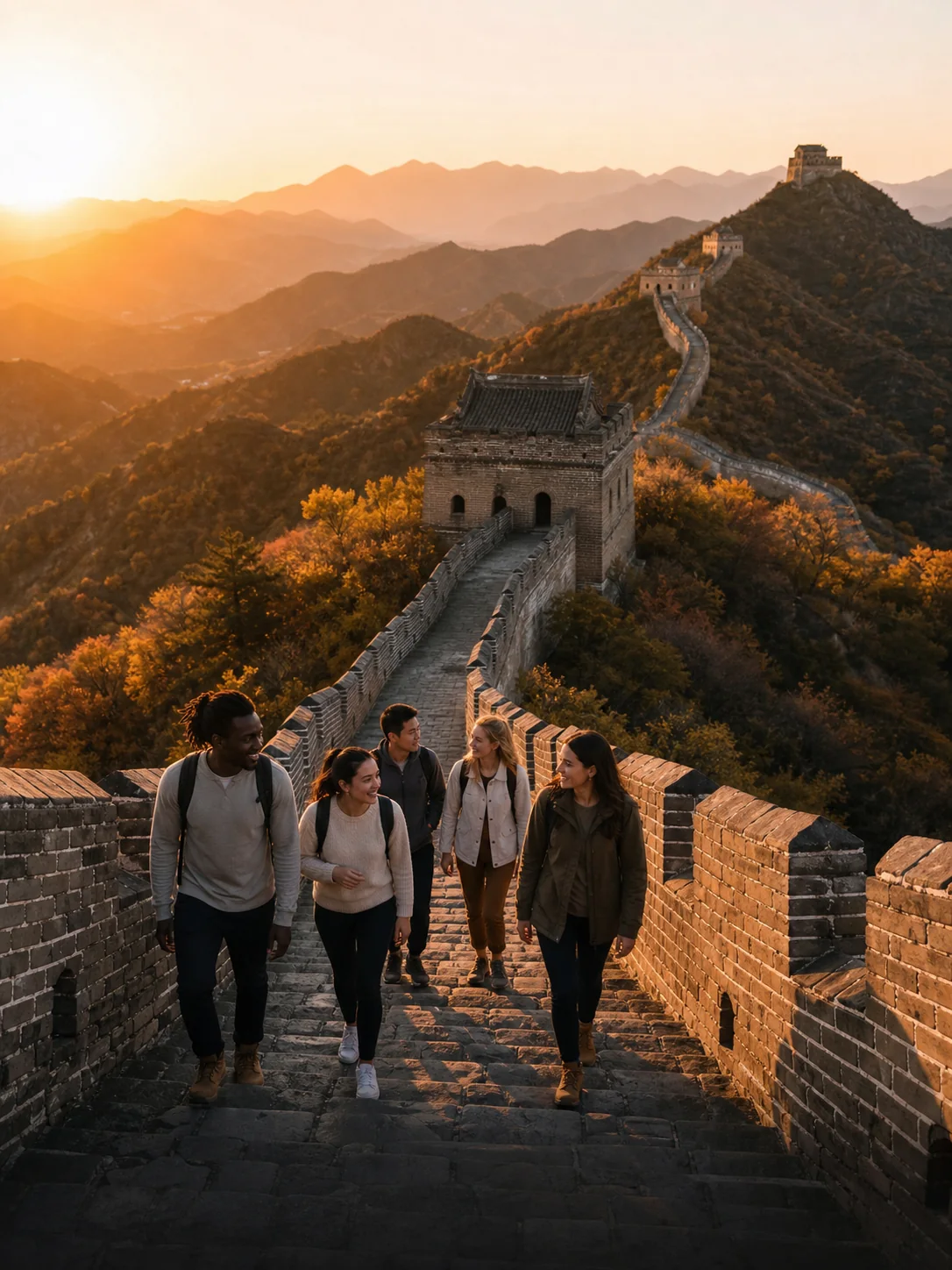
慕田峪长城The wall is a defensive landscape rather than a single line built at one moment. Mutianyu’s restored Ming watchtowers reveal how soldiers used terrain, sightlines and beacon communication to control a mountain corridor.
Watchtowers, ridge views and Ming defensive engineeringOPEN COMPLETE GUIDE →03 · Allow 2–3 hours and arrive early to see local morning life as well as the monuments.Temple of Heaven
天坛公园This was not an ordinary temple visit. Ming and Qing emperors performed state rituals here to connect heavenly order, harvest and legitimate rule. The geometry—round for heaven, square for earth—turns cosmology into architecture.
Ritual landscape and the Hall of Prayer for Good HarvestsOPEN COMPLETE GUIDE →04 · 3–5 hoursSummer Palace
颐和园Read the lake as political theatre, not just a beautiful park.
QING IMPERIAL GARDENOPEN COMPLETE GUIDE →05 · 1–2 hoursJingshan Park
景山公园The best city view is also the final piece of the palace plan.
CENTRAL AXIS VIEWPOINTOPEN COMPLETE GUIDE →06 · 1.5–2.5 hoursLama Temple
雍和宫A prince’s residence became Beijing’s most important Tibetan Buddhist monastery.
TIBETAN BUDDHIST TEMPLEOPEN COMPLETE GUIDE →07 · 3–5 hoursShichahai, Drum & Bell Towers
什刹海 · 钟鼓楼Read old Beijing through water, timekeeping and lived alleys.
HUTONG LANDSCAPEOPEN COMPLETE GUIDE →08 · 2–3 hoursBeihai Park
北海公园A thousand years of imperial garden-making gathered around one lake and one white stupa.
IMPERIAL LAKE GARDENOPEN COMPLETE GUIDE →Start with these anchors—then use the complete directory above
Forbidden City
故宫博物院Enter from the south and notice how gates, courtyards and halls stage increasing exclusivity. The outer court served grand ceremony; the inner court held the emperor’s household and daily life. Pu Yi’s childhood gives the final imperial rooms a human scale.
Imperial planning, timber halls and the Central AxisOpen the complete Forbidden City story: rooms, emperors and route →Allow 3–5 hours; advance real-name booking and the original passport are normally essential.
Wangfujing for broad hotel choice; Qianmen for older-city atmosphere; Jingshan for a quieter north-side base.
Use the live route to Tian’anmen East/West, then follow the official visitor entrance. Most visits exit north, so plan the onward route before entering.
Use the exact Chinese entrance or pickup point, not simply “Forbidden City”; road controls can prevent curbside drop-off.
Try Beijing roast duck, zhajiangmian or palace-style snacks away from the most congested gate frontage.
Mutianyu Great Wall
慕田峪长城The wall is a defensive landscape rather than a single line built at one moment. Mutianyu’s restored Ming watchtowers reveal how soldiers used terrain, sightlines and beacon communication to control a mountain corridor.
Watchtowers, ridge views and Ming defensive engineeringOpen the complete Mutianyu story: towers, generals and routes →Protect most of a day. Weather, shuttle queues and cable-car operating conditions shape the real schedule.
Stay in central Beijing for a first trip; choose a verified Mutianyu guesthouse only for a deliberate overnight wall experience.
There is no direct metro to the wall. Use an official/verified shuttle, private transfer or a carefully planned public-transport combination.
Pin “慕田峪长城游客服务中心” and confirm whether tolls, waiting and return travel are included before leaving Beijing.
Village restaurants serve northern home-style dishes; confirm price and portion before ordering.
Temple of Heaven
天坛公园This was not an ordinary temple visit. Ming and Qing emperors performed state rituals here to connect heavenly order, harvest and legitimate rule. The geometry—round for heaven, square for earth—turns cosmology into architecture.
Ritual landscape and the Hall of Prayer for Good HarvestsOpen the complete Temple of Heaven ritual story and route →Allow 2–3 hours and arrive early to see local morning life as well as the monuments.
Qianmen gives easy access to the old-city core; Chongwenmen is practical for metro connections and larger hotels.
Tiantandongmen is the usual planning anchor; verify the gate that matches the buildings you want to see.
Pin the exact east, north, west or south gate in Chinese. The park is large and the wrong gate adds substantial walking.
Combine with douzhi only if curious, or choose more approachable jianbing, noodles and Beijing pastries.
Hotel and transport freshness: the stay guidance recommends areas rather than promising a particular property’s live inventory. Before paying, verify the exact hotel, foreign-passport guest name, cancellation terms, metro exit and vehicle pickup point in the current provider or map.
Eat the city, not a generic checklist
Peking duck
A formal roast-duck meal is about carving, wrappers, condiments and sequence—not only the crisp skin.
Zhajiangmian
Wheat noodles with fermented soybean sauce and fresh garnishes; an everyday northern counterpoint to imperial dining.
Copper-pot hotpot
Thin lamb cooked quickly in a charcoal-heated pot, traditionally paired with sesame sauce.
The one transport rule to remember
Beijing is physically large. Group each day by area, keep the exact Chinese gate for every attraction and treat the Great Wall as a separate transfer day. Airport, railway station and palace entrances are not interchangeable map pins.
Sources used for this city story
Reviewed 23 August 2026. Historical interpretation is based on the sources below; ticketing, opening, transport, hotel and restaurant conditions can change and must be checked again before payment or travel.